
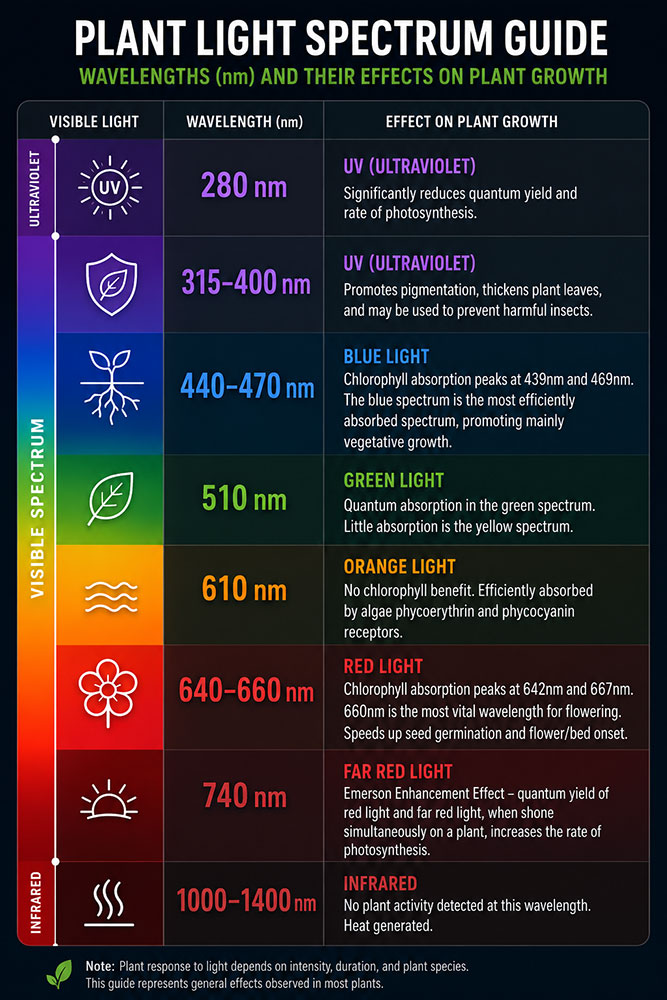
The basic principle behind photosynthesis is a fascinating manipulation of a narrow band of visible frequencies on the vast electromagnetic spectrum. To understand why BLUE-X® is so effective, we must look at how light quality dictates plant behavior.
The Foundation of Growth
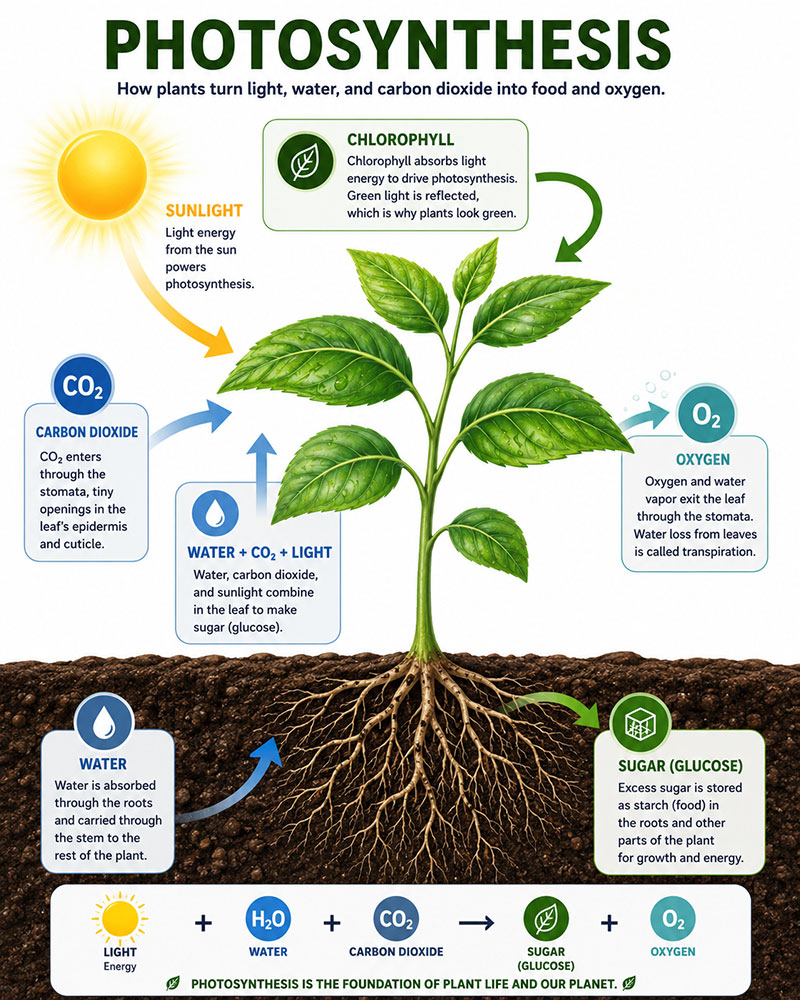
Photosynthesis is the biochemical process in which plants, algae, and some bacteria harness light energy to produce food. This process is vital to life on Earth, providing nourishment for almost all living things and producing a large portion of our atmospheric oxygen.
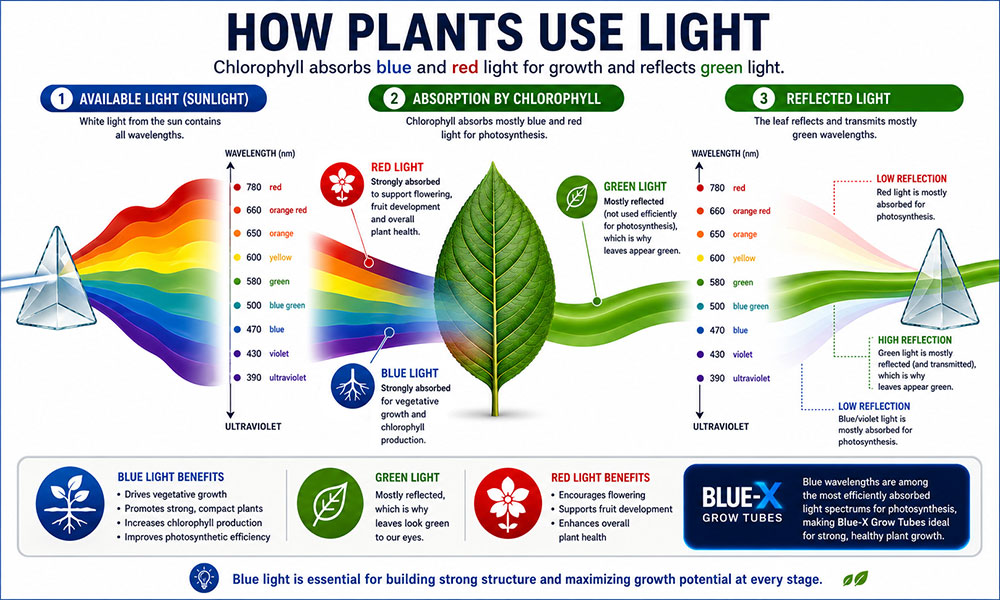
Light Quality refers to the specific wavelengths (colors) of light emitted from a source. While sunlight contains the full spectrum, plants are highly selective. Using a standard prism, we can see the spectrum break into violet, indigo, blue, green, yellow, orange, and red. While plants use the entire spectrum, blue and red are the primary drivers of energy conversion. However, these two colors signal the plant to grow in very different ways.
The Science of Shape: Photomorphogenesis
Beyond just providing energy, light acts as an instructional manual for the plant — a process known as Photomorphogenesis.
- Red and Far-Red Light: Often signals the plant to stretch upward to compete for sunlight.
- Blue Light: Slows the vertical stretch slightly, signaling the plant to develop thick stems, dense leaf matter, and robust root systems while still growing at accelerated rates producing an even root to shoot ratio as nature intended.
Many grow tubes on the market today focus heavily on red and far-red light to trigger the Emerson Enhancement Effect. While this accelerates height, it often results in etiolation — popularly known as the “Spindly Growth” effect. This creates thin, elongated trunks and weak root masses that are unable to support the plant’s own weight once the tube is removed.
Why Blue-X Makes the Difference
A tall tree or vine is not a success if it lacks a structural foundation. Blue light is a primary driver of photosynthesis and stimulates chlorophyll more than any other color. Furthermore, blue light is essential for Stomatal Control; it triggers the opening of the stomata (pores), which increases CO2 intake and revs the plant’s metabolic engine.

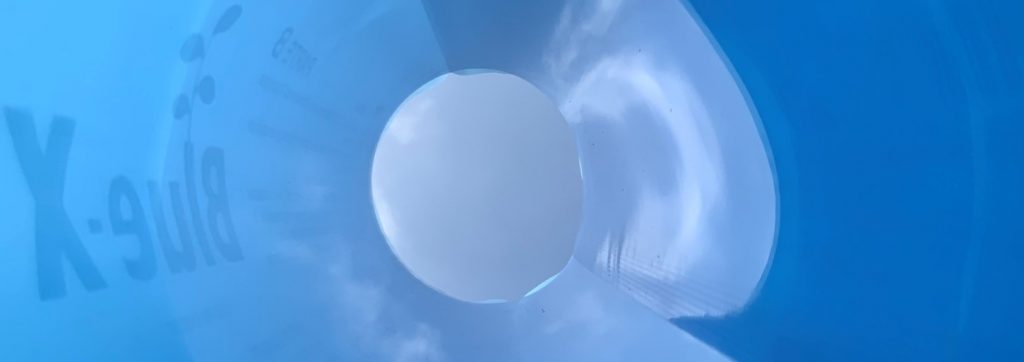
BLUE-X Shelters are engineered to address the common problem of “starvation” or “light‑deprivation stress” in young vines, trees, and plants. When a sapling is forced to “climb” toward a small circle of blue light at the top of an opaque tube, it exhausts its energy reserves on vertical height. The BLUE‑X® proprietary blue color blend allows a balanced wavelength of sunlight to penetrate the grow tube wall.
This balance allows the plant to thrive as if it were in an uncontrolled, natural setting. The result is:
- Greater PAR (Photosynthetically Active Radiation): Specifically in the critical 390 to 740 nm range.
- Increased Root Mass: Establishing a deep foundation for nutrient uptake.
- Stem Taper: Producing a self-supported, tapered trunk rather than a “noodle.”
- UV Protection: While UV light can damage plant DNA, our tubes block harmful UV rays, while the blue light that passes through actually assists the plant in repairing existing UV damage.
Technical Breakdown
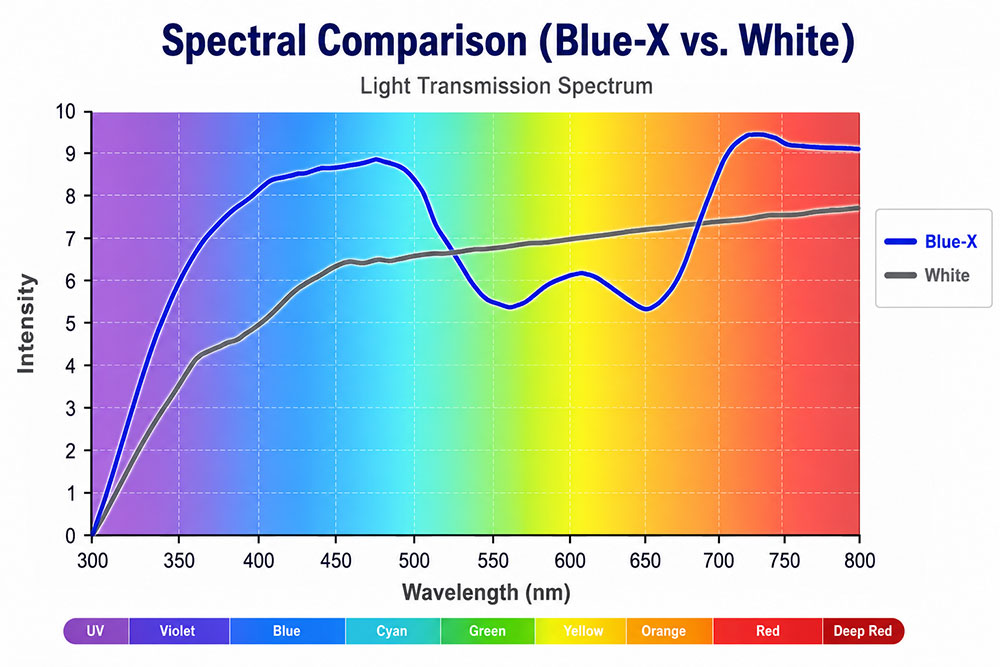
The following illustrations further demonstrate the Blue-X advantage:
- The Absorption Phenomenon: When sunlight passes through a leaf, dark bands appear in the blue (390–500 nm) and red (650–740 nm) spectrums, proving that chlorophyll is “absorbing” these specific wavelengths. BLUE-X is engineered to provide a higher ratio of these specific frequencies.
- Spectral Advantage: Scientific studies in Germany comparing BLUE-X to standard white film (Weisse Folie) show that our shelters provide significantly higher light transmission in the beneficial ranges (300–530 nm and 680+ nm) while reducing the less-effective green/yellow “middle” light.
By allowing the right balance of scattered sunlight, CO2 flow, moisture, and temperature, BLUE-X operates like a sophisticated individual greenhouse. We have been helping growers achieve 95% to 100% success rates in vineyards, orchards, and reforestation projects since 1992.
Build Stronger Plants from the Ground Up
Whether you’re cultivating a single grapevine or replanting acres of forest, Blue‑X Grow Tubes assists in delivering robust roots systems, strong tapered self‑supporting stems and trunks at accelerated growth rates — with 3 decades of proven results in vineyard, orchard, and reforestation projects, Blue‑X technology gives growers a trusted, reliable start for every planting. Contact us today for assistance or to order grow tubes for your next project.
FAQs
Why is blue light better for roots than red light?
While red light promotes vertical “stretch” (apical dominance), blue light inhibits cell elongation and encourages the plant to invest energy into structural diameter and root biomass. This creates a balanced root-to-shoot ratio, essential for long-term survival after the tube is removed.
Do Blue-X tubes protect against UV damage?
Yes. High-energy UV-B rays can damage plant DNA and slow photosynthesis. Our tubes are engineered to block harmful UV while specifically allowing the “repairing” blue wavelengths to pass through.
Can I use these for both vines and hardwood trees?
Absolutely. Whether it’s a grapevine or an oak seedling, the biological need for a balanced light spectrum remains the same. The blue-tinted PET film ensures that any light-demanding species gets the signals it needs for a sturdy trunk.
How does the "Emerson Enhancement Effect" work with Blue-X?
The Emerson Effect shows that photosynthesis increases significantly when plants are exposed to both Red and Far-Red light simultaneously. Blue-X tubes are designed to provide this “boost” while adding the blue light necessary to prevent the weak, “leggy” growth often caused by Red-only environments.
Additional Reading:
- Michigan State University – Blue Light and Plant Growth: A great PDF source explaining the physiology.
- American Society for Horticultural Science (ASHS): For peer-reviewed studies on light spectrums.
- USDA Forest Service – Tree Shelter Research: Studies on the importance of seedling establishment and more.
https://doi.org/ | https://www.fs.usda.gov/ | https://www.srs.fs.usda.gov/
